Land Conversion Application Process and Status Check on Banglarbhumi (West Bengal) Updated Guide for 2026
Land conversion is the legal step that changes a plot’s “recorded land use” from agricultural to non-agricultural purposes like homestead, commercial, or industrial use. If you build or run a business on agricultural land without conversion, you’re essentially creating a legal risk that can come back as penalties, refusal of building plan sanction, loan issues, or even demolition notices in extreme cases.
I’ve helped landowners and buyers in West Bengal navigate Banglarbhumi applications and document mismatches (Khatian errors, plot area differences, old deeds missing schedules). In this guide, I’ll walk you through the same practical, real-world process I follow so you can apply it the first time correctly and track your conversion status without confusion.
What is a Land Conversion Application
A Land Conversion Application is the official request to the Land & Land Reforms authority to change the classification, character, use of land in government records.
In plain words:
- Agricultural land is meant for cultivation and allied activities.
- Non-agricultural land includes homestead (bastu), commercial, industrial, institutional uses, etc.
If you want to use agricultural land for a house, shop, warehouse, factory, or any non farming project, you typically need conversion first. This is what keeps your land use legally aligned with planning, taxation, and record systems.
When You Need Land Conversion (Practical Scenarios)
From my experience, people usually apply for conversion when:
- You’re planning home construction on agricultural recorded land.
- You want building plan approval from the municipality/panchayat.
- You’re selling land to a developer (buyers insist on conversion)
- You’re applying for a bank loan where the bank checks the land nature.
- You’re setting up commercial or industrial activity.
- You need clean records for future mutation, partition, or registration.
Quick clarity: Conversion vs Mutation (many people mix this up)
| Process | What It Does | When It Applies |
|---|---|---|
Mutation | Updates ownership name after sale/inheritance | After registration / inheritance |
Conversion | Changes land use classification (agri to non-agri etc.) | Before construction/business use |
Banglarbhumi Portal (Where the Online Application Happens)
Banglarbhumi is the official West Bengal land records and citizen services portal where you can file several services online, including conversion applications and status checks.
What I like about using the portal is that it reduces unnecessary visits and gives you an application number for tracking.
Documents Required for Land Conversion (Complete Checklist)
The exact list can vary based on applicant type and land nature, but this is the practical checklist you should prepare before starting.
Document checklist (recommended)
| Document | Why It's Needed | Tip |
|---|---|---|
Proof of ownership / land record reference | Establishes you’re entitled to apply | Keep Khatian details handy |
Registered deed (sale deed / deed of transfer) | Supports title chain | Scan full deed with schedules |
Recent land revenue / tax receipt | Shows dues position | Use latest paid receipt |
Identity proof (Aadhaar etc.) | Applicant verification | Match name spelling with deed |
Address proof | Contact and verification | Optional in some cases |
Power of Attorney (if applicable) | If POA holder applies | Must be valid and relevant |
NOC (if applicable) | For restricted/linked cases | Only where demanded |
Any supporting land classification papers | Helps avoid objections | Especially if records are old |
File format tip (to avoid upload failure)
- Use PDF
- Keep each file under 2 MB (as commonly required on many portal forms)
- Scan at 150–200 dpi to balance clarity + size.
Step-by-Step: How to Apply for Land Conversion on Banglarbhumi (Online)
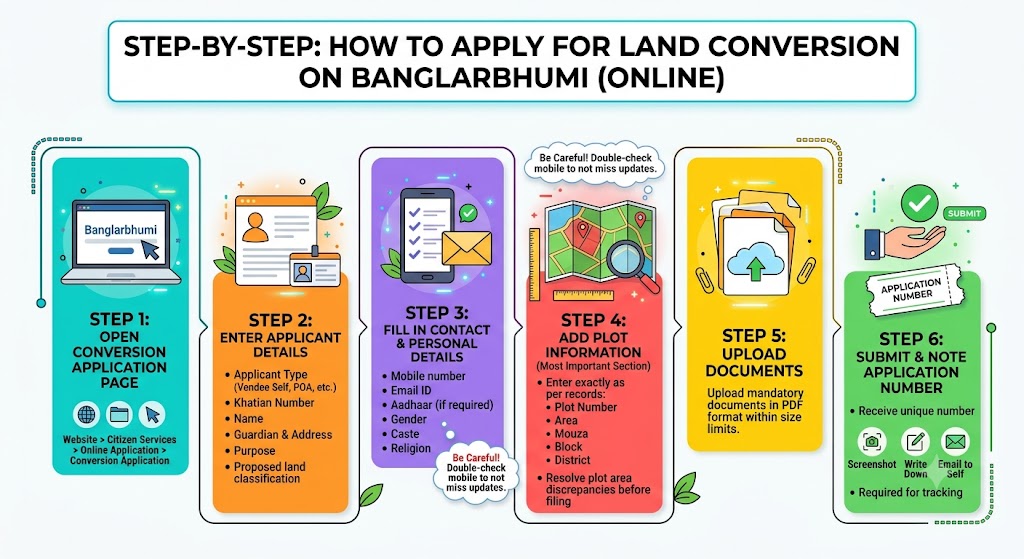
Here’s the clean sequence that works for most applicants.
Step 1: Open the conversion application page
- Go to Banglarbhumi
- Choose Citizen Services
- Select Online Application
- Click Conversion Application
Step 2: Enter applicant details
You’ll typically be asked for:
- Applicant Type (common options shown: Vendee Self, Power of Attorney, Others)
- Khatian Number
- Applicant name, guardian name, and address
- Purpose of conversion (what you want to use it for)
- Proposed new land classification
Step 3: Fill in contact and personal details
Add details like:
- Mobile number
- Email ID
- Aadhaar (if asked)
- Gender
- Caste and religion (if asked)
Be careful here. I’ve seen applications get delayed because the mobile number is wrong, and the applicant misses updates.
Step 4: Add plot information (most important section)
Enter plot-level details exactly as per records:
- Plot number
- Area
- Mouza
- Block
- District
If your plot area indeed differs from RoR (record), resolve that first or be ready for an objection.
Step 5: Upload documents
Upload your PDFs within size limits.
Step 6: Submit and note the application number
After submission, you’ll receive an Application Number. Save it:
- Screenshot it
- Write it down
- Email it to yourself.
You’ll need it for tracking and follow-ups.
Land Conversion Fee (Per Decimal) Updated Tables (Rural, Municipal excluding KMDA, KMDA)
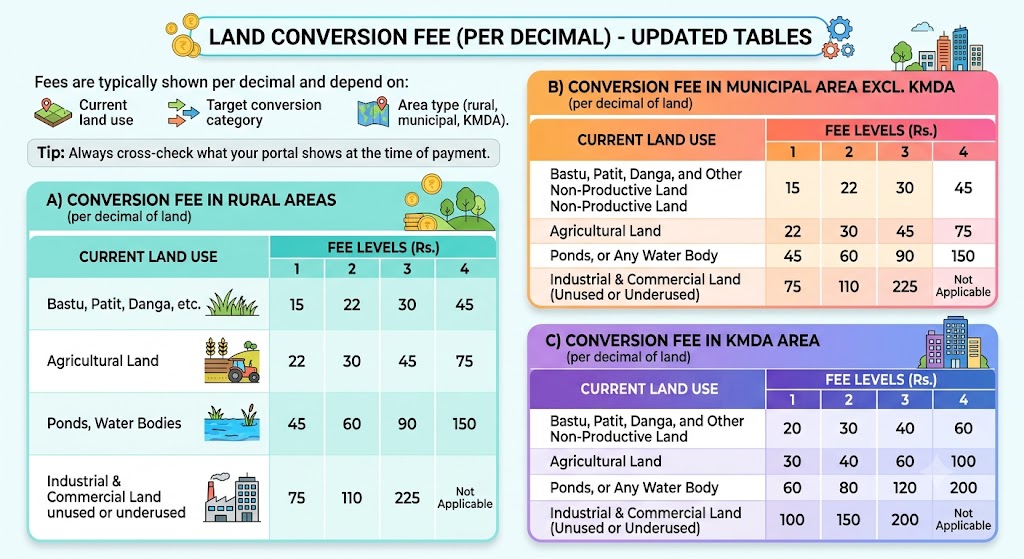
Fees are typically shown per decimal and depend on:
- Current land use
- Target conversion category
- Area type (rural, municipal, KMDA)
Below are the structured fee tables commonly referenced for these categories. Always cross-check what your portal shows at the time of payment.
A) Conversion Fee in Rural Areas (per decimal of land)
| Land Category | Tier 1 | Tier 2 | Tier 3 | Tier 4 |
|---|---|---|---|---|
Bastu, Patit, Danga, and any other land not currently in agricultural or other productive use | Rs. 15 | Rs. 22 | Rs. 30 | Rs. 45 |
Agricultural Land | Rs. 22 | Rs. 30 | Rs. 45 | Rs. 75 |
Ponds, or any water body | Rs. 45 | Rs. 60 | Rs. 90 | Rs. 150 |
Industrial and Commercial Land unused or underused | Rs. 75 | Rs. 110 | Rs. 225 | Not Applicable |
B) Conversion Fee in Municipal Area excluding KMDA (per decimal of land)
| Land Category | Tier 1 | Tier 2 | Tier 3 | Tier 4 |
|---|---|---|---|---|
Bastu, Patit, Danga, and Other Non-Productive Land | Rs. 15 | Rs. 22 | Rs. 30 | Rs. 45 |
Agricultural Land | Rs. 22 | Rs. 30 | Rs. 45 | Rs. 75 |
Ponds, or Any Water Body | Rs. 45 | Rs. 60 | Rs. 90 | Rs. 150 |
Industrial and Commercial Land (Unused or Underused) | Rs. 75 | Rs. 110 | Rs. 225 | Not Applicable |
C) Conversion Fee in KMDA Area (per decimal of land)
| Land Category | Tier 1 | Tier 2 | Tier 3 | Tier 4 |
|---|---|---|---|---|
Bastu, Patit, Danga, and Other Non-Productive Land | Rs. 20 | Rs. 30 | Rs. 40 | Rs. 60 |
Agricultural Land | Rs. 30 | Rs. 40 | Rs. 60 | Rs. 100 |
Ponds, or Any Water Body | Rs. 60 | Rs. 80 | Rs. 120 | Rs. 200 |
Industrial and Commercial Land (Unused or Underused) | Rs. 100 | Rs. 150 | Rs. 200 | Not Applicable |
Important Steps Before Submission (Don’t Skip These)
Before you hit final submit, I always do this checklist:
- Read the SOP for Conversion Disposal
Many rejections happen because applicants select the wrong purpose/class. - Captcha verification
Sounds small, but failed captcha sessions sometimes lead to incomplete submissions. - Self-declaration
Read it and confirm details are accurate. - Final review
- Khatian no.
- Plot no.
- Mouza
- Area
- Purpose
- Submit and save the application number
This is your tracking key.
How to Check Land Conversion Application Status on Banglarbhumi
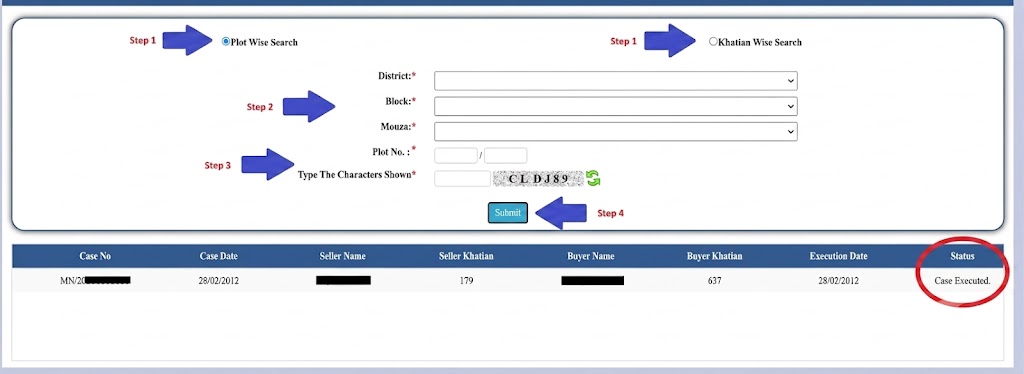
Once you’ve applied, tracking is straightforward if you enter details correctly.
Step-by-step status check
- Log in to Banglarbhumi portal
- Go to Citizen Services
- Click Online Service Status
- Select Conversion Status
- Choose search method:
- Plot Wise
- Khatian Wise
- Enter:
- District
- Block
- Mouza
- Plot number (if plot-wise)
- Captcha code
- Click Submit to view the current status
Common Status Messages and What They Usually Mean
These are typical patterns I see across online service workflows.
| Status Message | What It Means | What To Do |
|---|---|---|
Submitted / Application Received | Your form is in the system | Keep application number safe |
Under Process / In Progress | Department is checking records | Wait, but keep documents ready |
Document Verification / Scrutiny | Documents being matched | Ensure uploads are readable |
Field Inspection Scheduled / Done | Site verification stage | Be available locally if contacted |
Objection Raised / Query | Something is missing or mismatched | Respond quickly with correct proof |
Approved / Conversion Order Issued | Conversion granted | Download/collect order and update records if needed |
Rejected | Application not accepted | Read reason and reapply after fixing |
Legal Framework and Why Conversion Matters (EEAT Explanation)
Land conversion isn’t “optional paperwork.” It’s what makes your land use defensible.
Why conversion is important
- Legal compliance
Non-agricultural use on agricultural land can trigger enforcement issues. - Urbanization and demand
India’s urban share has steadily increased (World Bank and UN DESA estimates place India’s urban population at roughly the mid-30 percent range in recent years), and with that comes rising pressure on land near roads, markets, and industrial corridors. - Project readiness
Proper land classification makes it easier to obtain:
- building plan approvals
- trade licenses
- utilities connections (in many cases)
- institutional finance
- Value and marketability
Converted land is typically easier to sell, mortgage, insure, and develop because the “use” aligns with the buyer’s intent.
Land Conversion Application Process (End-to-End Flow)
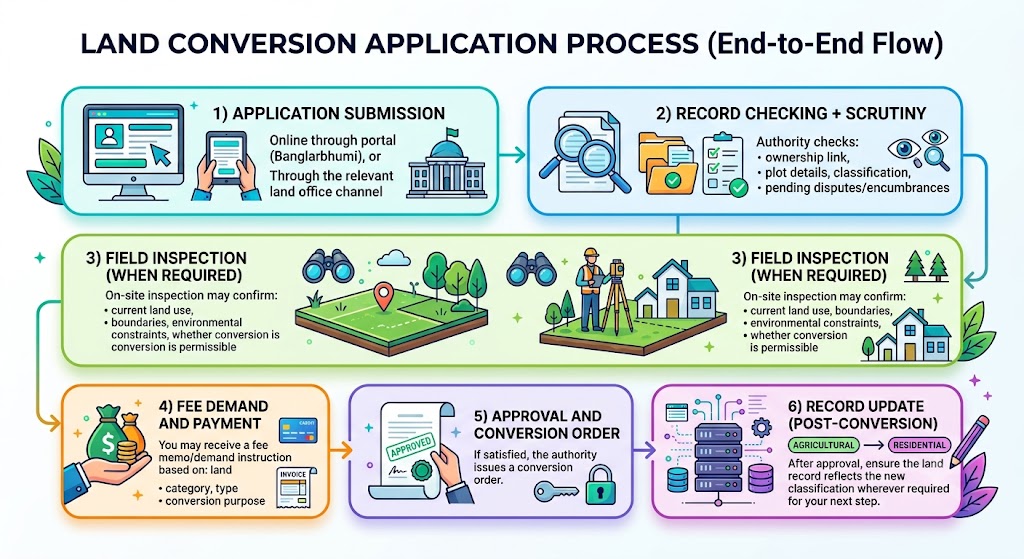
Even when you apply online, the government workflow usually follows this pattern:
1) Application submission
- Online through portal (Banglarbhumi), or
- Through the relevant land office channel (where applicable)
2) Record checking + scrutiny
Authority checks:
- ownership link
- plot details
- classification
- pending disputes/encumbrances (as per available records)
3) Field inspection (when required)
An on-site inspection may confirm:
- current land use
- boundaries
- environmental constraints
- whether conversion is permissible
4) Fee demand and payment
You may receive a fee memo/demand instruction based on:
- land category
- location type (rural/municipal/KMDA)
- conversion purpose
5) Approval and conversion order
If satisfied, the authority issues a conversion order.
6) Record update (post-conversion)
After approval, ensure the land record reflects the new classification wherever required for your next step.
Common Problems That Cause Delay or Rejection (Real-World)
These are the most common “friction points” I see:
- Ownership/title not clean
- missing link deed
- pending dispute
- inheritance not mutated
- Mismatch in plot details
- plot area differs across deed vs RoR
- mouza spelling or JL number confusion
- Restricted land
- wetlands, forest-adjacent, protected zones
- water bodies (ponds) face higher scrutiny and restrictions
- Unreadable uploads
- blurred scans
- cut pages
- missing schedules/maps
- Wrong conversion purpose chosen
Selecting homestead vs commercial vs allied-agri incorrectly can trigger objections
Best Practices to Get Approved Faster (What I Recommend)
If you want the smoothest path, do this:
- Confirm land classification first
Check RoR/Khatian details so you’re not applying blindly. - Fix title issues before applying
If mutation is pending, complete it (or at least understand the risk). - Keep documents organized
Maintain:
- one folder for deeds
- one folder for receipts
- one folder for ID proofs
Keep both digital and physical copies.
- Follow local plans/zoning
In developing areas, zoning/master plans matter. Don’t assume every plot can become commercial. - If it’s a high-value project, consult a professional
For group housing, industrial, or multi-plot conversion, a land legal consultant often saves months.
FAQs (Answered Clearly)
Q1. What are the eligibility criteria for converting agricultural land to non-agricultural use?
You typically need:
- lawful ownership (or legal authority such as POA where accepted)
- clear title (no serious disputes)
- compliance with zoning/land-use rules
- land that is not prohibited/restricted for conversion
Q2. Which records are required to submit a land conversion application?
Commonly required records include:
- Khatian/land record references
- registered deed with schedules
- recent tax/land revenue receipts
- identity/address proof
- POA/NOC where applicable
Q3. What is the step-by-step procedure to apply online?
Go to Banglarbhumi → Citizen Services → Online Application → Conversion Application → fill applicant + plot details → upload documents → submit → save application number.
Q4. Are there fees for conversion and how are they calculated?
Yes. Fees are usually calculated per decimal and depend on:
- current land use type
- intended converted use
- jurisdiction area (rural/municipal/KMDA)
I’ve provided the commonly referenced fee tables above, but always confirm inside the portal.
Q5. How long does the approval process usually take?
Timelines vary based on:
- document clarity
- need for inspection
- office workload
- objections and corrections
If your records are clean, it’s typically faster. If there’s a mismatch or objection, it can extend significantly.
Q6. What are common reasons for rejection or delay?
- title disputes or missing deeds
- incorrect plot/khatian details
- poor scan uploads
- restricted land category
- wrong conversion purpose selection
Q7. How can I check my conversion application status online?
Banglarbhumi → Citizen Services → Online Service Status → Conversion Status → search plot-wise or khatian-wise → enter district/block/mouza + plot/khatian → submit.
Q8. What should I do if my status is pending for a long time?
Do this in order:
- Re-check you entered the correct plot/khatian during status search
- Review whether any objection/query is shown
- Keep your application number ready and follow the official escalation path shown on the portal or at the concerned office
- If needed, submit the requested clarification quickly
Q9. Is there a helpline for grievances?
Most portals provide a help/grievance option or contact details. Use only official contact points shown on Banglarbhumi and keep your application number handy.
Q10. Can conversion status be verified through GIS or official government platforms?
In some cases, plot and record layers are visible through official map/record services, but conversion approval itself should be verified through the official order/document and the updated land record entries.
Final Thoughts
If you’re serious about building, selling, financing, or developing land in West Bengal, land conversion is one of those steps you want done cleanly, not “somehow managed.” When you apply through Banglarbhumi with correct plot details, readable documents, and the right conversion purpose, your chances of a smooth approval jump dramatically.